

Spokesperson: Alexis Cathalifaud, CEO
As demand for artificial intelligence compute continues to grow, the infrastructure supporting that demand is becoming a strategic consideration in its own right. Companies across the sector are racing to secure access to increasingly powerful GPUs, while questions around electricity, data-center capacity, cooling and connectivity are becoming harder to separate from the compute itself.
Clichmont is taking a different approach. Rather than building its model primarily around rented GPU capacity, the company is focused on owning and controlling the physical infrastructure on which successive generations of AI hardware can operate. In this interview, Clichmont CEO Alexis Cathalifaud discusses why the company believes power and data-center infrastructure could become the more durable bottlenecks, how it approaches site selection and the challenges of scaling physical infrastructure, as well as the role of its $CLAI token within the broader ecosystem.
1) Every company in this category is fighting over GPU access right now. Clichmont’s answer is to build the data centers instead of renting the chips. Why does ownership matter more than access?
Because GPU access gives you compute; infrastructure ownership gives you control over the economics of compute.
For a company like Clichmont, owning or controlling the data-center layer can matter more strategically than simply securing rented GPUs. When you rent GPU capacity from a hyperscaler or GPU cloud, you inherit someone else’s pricing, availability, power constraints, networking architecture, deployment schedule, and margins. When demand spikes, access can become expensive or constrained.
Owning the infrastructure changes the equation. Clichmont can potentially decide which GPUs to deploy, when to upgrade them, how densely to install them, how power and cooling are engineered, and how the capacity is commercialized. The same facility can also evolve from one GPU generation to the next rather than tying the business thesis to a particular chip.
There is another important distinction: GPUs depreciate quickly; power-ready data-center capacity is a longer-lived strategic asset. A GPU generation may become economically less competitive within a few years, whereas land, grid connections, substations, cooling infrastructure, fiber connectivity and permitted megawatts can remain valuable across multiple generations of accelerators.
That makes the scarce resource increasingly not just the GPU itself, but the ability to energize thousands of GPUs at scale. A company can buy chips and still have nowhere suitable to deploy them. Securing 10,000 GPUs is one problem; securing the tens of megawatts of reliable electricity, cooling and network infrastructure required to operate them is another.
2) You’re up against companies that are already public or heading there – CoreWeave, Crusoe, Lambda. What do you think their model gets wrong, if anything?
I don’t think CoreWeave, Crusoe or Lambda got the model wrong. They proved that AI compute is a massive market. Where we differ is in what we believe will remain scarce. GPUs change every generation. The durable bottleneck is the infrastructure required to run them — power, land, cooling and connectivity. Clichmont’s thesis is that rather than competing only to rent the latest GPU, we want to control the infrastructure on which successive generations of GPUs will operate. In a market where everyone is chasing chips, we’d rather own the place where the chips have to live
3) There’s a growing argument that energy, not chips, is the actual bottleneck for AI infrastructure. How much does that shape where and how Clichmont builds?
Energy shapes almost every infrastructure decision we make. A GPU without reliable power is just expensive hardware sitting in a rack. We believe the real competition over the next decade won’t simply be for GPUs—it will be for megawatts.
So when Clichmont evaluates a site, we don’t start by asking where we can find the cheapest building. We ask: where can we secure reliable power, at the right economics, with the ability to scale? What’s the time-to-power? What’s the grid situation? What cooling architecture does the climate allow? And can that site support the next generation of GPUs, not just the ones we’re installing today?
That’s one reason locations with strong energy fundamentals are strategically interesting to us. Chips can be shipped around the world. You can’t ship 100 megawatts. The compute ultimately has to go where the energy is.
So I wouldn’t say chips stop being a bottleneck. They remain critical. But increasingly, owning GPUs isn’t enough. The competitive advantage is being able to power, cool and operate them economically at scale. That’s what we’re building Clichmont around.
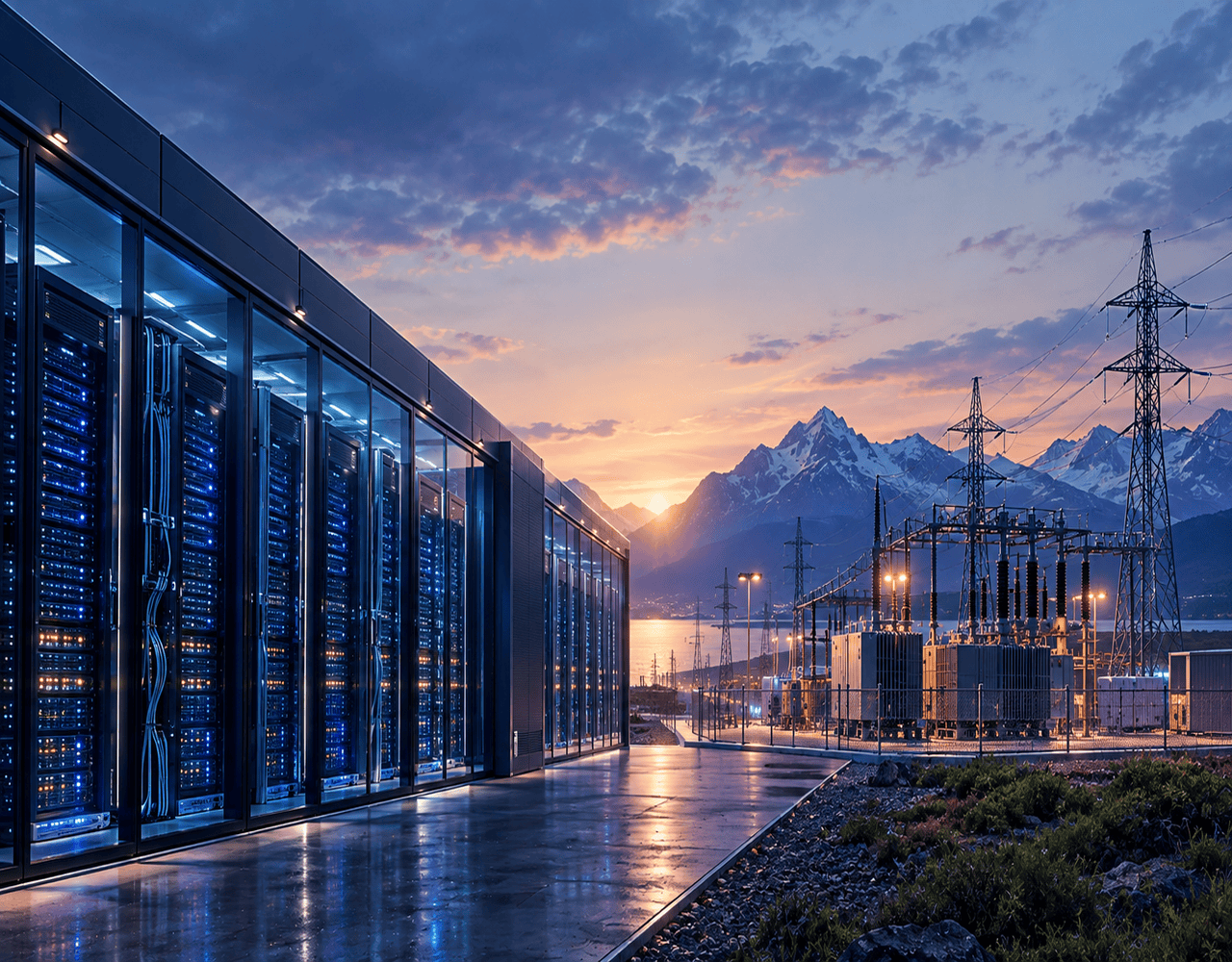
4) Clichmont’s sites range from a solar-powered facility in Alicante to a new build in Bodo, Norway. What actually decides where a data center gets built – is it about energy, land, climate, something else?
We don’t choose a location because one variable looks attractive. We choose it because the entire infrastructure equation works.
Power is the first filter: how many megawatts can we secure, at what cost, how reliable is that supply, and—critically—how quickly can it actually be delivered? Then we look at cooling, climate, fiber connectivity, land, permitting, security and the ability to expand.
Bodø and Alicante are interesting precisely because they represent different strengths. Northern Norway gives us a climate that can support efficient cooling and a strong energy environment. Alicante gives us a different energy profile and the opportunity to integrate solar into the infrastructure strategy. We don’t believe every Clichmont data center needs to look identical—the architecture should respond to the resources of the location.
And land by itself isn’t particularly valuable to us. A cheap parcel with no scalable power or fiber is not a data-center site. What matters is whether we can turn that location into reliable, economically competitive compute capacity.
Ultimately, we’re not really looking for land. We’re looking for places where energy, connectivity, cooling and scalability converge. That’s where we build.
5) This is an infrastructure company with a token attached to it. For a reader who’s skeptical of that combination, what’s the honest case for why $CLAI exists at all?
The skeptical view is completely fair. A token shouldn’t exist just because a company operates in AI. If $CLAI were simply a financing wrapper around our data centers, I wouldn’t consider that a compelling reason to create it.
Clichmont is the infrastructure business. It builds and operates compute capacity. $CLAI is intended to be a digital economic layer around the broader ecosystem — something that can eventually support on-chain participation, treasury activity and community governance in ways that conventional equity isn’t designed to do.
And we have to earn the right to make that distinction. The physical infrastructure has to exist independently of the token, and the token has to demonstrate real utility independently of speculation. If we can’t show both, then the skepticism is justified.
So I wouldn’t ask anyone to believe in $CLAI simply because Clichmont owns GPUs or builds data centers. The test is much simpler: does the token eventually do something useful, transparent and measurable that couldn’t be accomplished as effectively with a normal database or conventional corporate structure? That’s the standard we should be held to.
6) What’s the hardest part of scaling physical infrastructure that people who’ve only built software tend to underestimate?
The hardest part is that physical infrastructure doesn’t scale at software speed. In software, if demand doubles, you can often provision more capacity quickly. In a data center, every additional megawatt has a physical dependency behind it — grid capacity, transformers, switchgear, cooling, fiber, permits, construction and ultimately hardware.
And those dependencies don’t move in parallel as neatly as people imagine. You can have the land and not have the power. You can have the power allocation and wait months for electrical equipment. You can have the building ready and still be waiting for a grid connection. One missing component can delay an entire deployment.
The other difference is that mistakes are expensive and difficult to reverse. Software can be patched overnight. You can’t patch a badly designed 50-megawatt electrical system overnight. You’re making capital decisions today based on what GPUs, power densities and cooling requirements may look like several years from now.
So the real skill isn’t simply building data centers. It’s sequencing capital, power, construction and customer demand so that they arrive at roughly the same moment. Build too early and you have expensive idle infrastructure. Build too late and the customer goes somewhere else.
That execution discipline is probably what people coming purely from software underestimate most. In physical AI infrastructure, speed matters — but timing matters even more.
7) If you had to name the biggest risk in betting on a build-it-yourself model instead of a capital-light rental model, what would it be?
The biggest risk is capital intensity combined with timing. When you build infrastructure yourself, you’re committing significant capital today against assumptions about demand, power economics and technology several years into the future.
A rental model gives you flexibility. If the market changes, you can reduce capacity, move providers or adopt the next generation of hardware. When you own the infrastructure, you don’t have that luxury. A substation, cooling system or data-center building is a long-duration decision.
For us, the biggest danger therefore isn’t simply spending too much — it’s building the wrong capacity, in the wrong place, at the wrong time. If you build ahead of demand, capital sits idle. If you build too slowly, you miss the market.
That’s why we don’t view ownership as ‘build everything ourselves.’ The objective is to control the strategic infrastructure while remaining flexible around technology. The building, power, cooling and connectivity should survive multiple generations of GPUs rather than becoming dependent on one hardware cycle.
So yes, the capital-light model has a real advantage: optionality. Our bet is that if we execute correctly, giving up some short-term optionality creates something more valuable over the long term — control over capacity, power economics and the physical infrastructure that AI increasingly depends on.
8) Three years from now, where do you want Clichmont to sit relative to the CoreWeaves and Nebiuses of the world?
Three years from now, I don’t expect Clichmont to be the biggest company in the category, and that’s not the objective. CoreWeave and Nebius have enormous scale and access to capital. Trying to replicate them would be the wrong strategy for us.
I want Clichmont to be recognized as one of the most efficient independent AI infrastructure operators in Europe — with real operating assets, secured power, high-density GPU capacity and a track record of bringing new compute online quickly.
Our advantage has to come from being disciplined about where we build and what we own. We want locations where the energy economics make sense, infrastructure designed around successive generations of accelerated computing, and the flexibility to serve enterprise AI, HPC and private compute rather than simply competing for GPU rental volume.”
If CoreWeave and Nebius are building hyperscale AI clouds, Clichmont can occupy a different position: a focused owner and operator of compute-ready infrastructure in strategically selected markets.
Conclusion
Clichmont’s strategy ultimately comes down to a long-term infrastructure bet: that access to GPUs will remain important, but the ability to power, cool, connect and operate those GPUs efficiently at scale will become an increasingly valuable advantage.
That approach comes with meaningful trade-offs. Building physical infrastructure requires substantial capital, long planning horizons and careful coordination between power, construction, hardware and demand. Clichmont’s thesis is that accepting those constraints can provide greater control over the infrastructure required for successive generations of AI compute. Whether that thesis proves out will depend less on the ambition of the model than on the company’s ability to execute it efficiently and at the right time.
